IBK Industrial Bank Q2 2026 Results: Interest Income Surged — So Why Did Net Profit Fall?
On July 27, 2026, IBK Industrial Bank released its first-half earnings report — and the numbers tell a puzzling story. Interest income hit a record high, yet net profit actually declined. Whether you already hold IBK stock or are thinking about adding it to your portfolio, here’s everything you need to know about the bank’s Q2 net profit, first-half performance, and its historic first-ever quarterly dividend.

Q2 Net Profit Came in at ₩689.5 Billion — Down 0.7% Year-Over-Year
IBK Industrial Bank posted a Q2 net profit of ₩689.5 billion, a modest 0.7% dip from the ₩694.4 billion recorded in the same period last year. In absolute terms, that’s a difference of just ₩4.9 billion — technically less than a one-percent decline. But when you zoom out to the full first-half picture, the pressure becomes more apparent.
On a consolidated basis, IBK’s net profit for the first half of 2026 totaled ₩1.4429 trillion, down 4.4% compared to the same period in 2025. On a standalone bank basis, net profit was ₩1.2078 trillion, a sharper drop of 9.0%. The larger decline in the standalone figure suggests that subsidiary performance helped cushion the blow to the parent bank’s bottom line.
Interest Income Grew Over 7% — So What Dragged Profit Down?
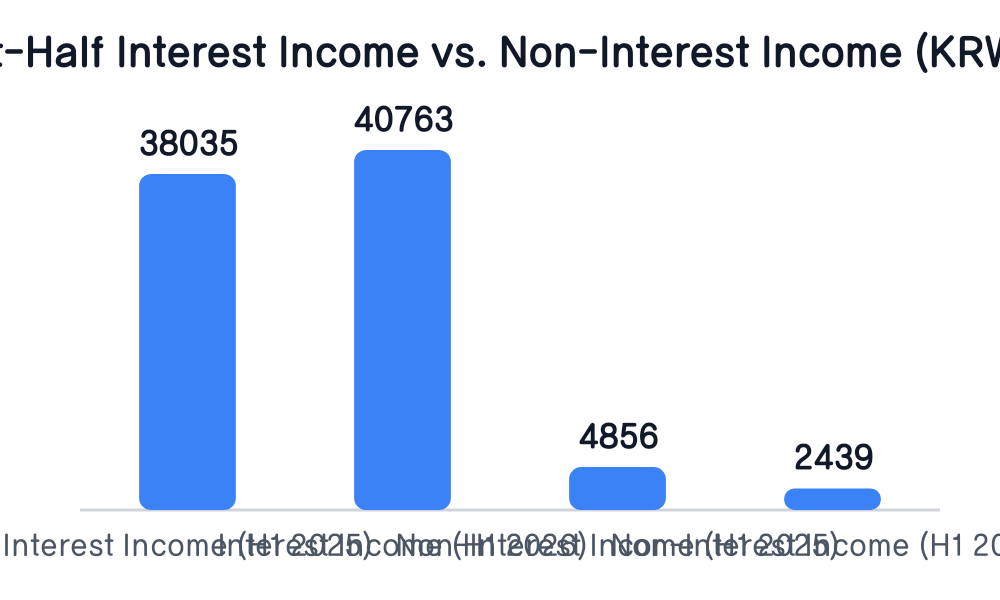
This is the key question. First-half interest income reached ₩4.0763 trillion, up 7.2% from ₩3.8035 trillion a year earlier. But non-interest income collapsed to ₩243.9 billion — a stunning 49.8% plunge from ₩485.6 billion in the prior year.
Two culprits drove that non-interest income drop: exchange rates and loan-loss provisions. The surge in the USD/KRW exchange rate generated ₩126.6 billion in foreign exchange valuation losses. Banks with large dollar-denominated assets tend to book paper losses on their balance sheets when the won weakens sharply, and IBK took a direct hit on that front. There’s also a base effect at play — non-interest income had surged an extraordinary 205.2% in the first half of 2025, making this year’s figures look all the more deflated by comparison.
SME Loans Hit ₩270 Trillion — Market Share at an All-Time High
The profit decline alone doesn’t paint a complete picture of IBK’s performance. As a policy bank mandated to support small and medium-sized enterprises, IBK is actually delivering on its core mission. SME loan balances grew ₩8.1 trillion, or 3.1%, from the end of last year to reach ₩270 trillion. As a result, IBK’s share of the SME lending market climbed to a record 24.6%.
Asset quality also remains relatively stable. The credit cost ratio edged up 5 basis points year-over-year to 0.46%, but the non-performing loan (NPL) ratio actually improved slightly, falling 1 basis point from year-end 2025 to 1.27%. Expanding the loan book aggressively while simultaneously reducing the bad-loan ratio is a meaningful achievement worth acknowledging.
IBK’s First-Ever Quarterly Dividend — Record Date Is July 31
For investors, this may be the most eye-catching announcement in the entire earnings release. In a move to strengthen shareholder returns, IBK Industrial Bank is implementing its very first quarterly dividend in the bank’s history. The record date is July 31, with a dividend of ₩210 per share.
Any shareholder on record by July 31 will receive ₩210 per share held. An IBK spokesperson commented, “Through our second-half organizational restructuring, we’ve secured the momentum needed to drive productive finance and an AI-led transformation. We will continue to expand shareholder returns through this inaugural quarterly dividend.” The introduction of a quarterly dividend structure signals a notable shift in how IBK approaches capital return to investors.
Second-Half Outlook: Exchange Rates and Provisions Remain the Wildcards
Many analysts believe the headwinds facing IBK won’t fully clear in the second half of the year. The credit cost ratio has already risen 5 basis points above last year’s level, and if economic uncertainty persists alongside a still-elevated exchange rate, provisioning costs could climb further. In short, the second-half story will largely be written by two variables: how quickly the won stabilizes, and whether SME delinquency rates hold their ground.
That said, the structural trend in interest income growth looks solid. With interest-earning assets expanding and funding costs being managed down simultaneously, a recovery in overall net profit is plausible in the second half — especially if the one-off FX valuation losses that weighed on non-interest income start to fade. With IBK now signaling a commitment to regular quarterly dividends, income-focused investors may find it worthwhile to take a fresh look at the stock from a shareholder-return perspective.
Sources
- IBK Industrial Bank H1 Net Profit Falls 4.4% on FX Losses — Seoul Economic Daily
- IBK Records ₩1.4429 Trillion H1 Net Profit, Down 4.4% YoY — Digital Daily
- IBK Industrial Bank H1 Net Profit ₩1.4429 Trillion, -4.4% vs. Prior Year — Asia Economy
- IBK Industrial Bank Announces H1 2026 Results, Including First-Ever Quarterly Dividend — EzyEconomy
- IBK H1 Profit Down 4.4% YoY — Impact of Exchange Rates and Loan-Loss Provisions — News2Day