Stop Flushing Your Old Meds: The Right Way to Dispose of Leftover Medications at Home
Half a pack of cold medicine. A mystery blister pack from a prescription you barely remember filling. An eye drop bottle used once and forgotten. Sound familiar? Open almost any household medicine cabinet and you’ll find a graveyard of expired and leftover medications. But here’s the real question: how are you actually getting rid of them? A 2025 survey by the Korea Environment Foundation, which polled 4,068 citizens nationwide, found that 9 out of 10 people know that expired medications should be disposed of separately. Yet among those who had thrown away medicine within the past year, nearly half admitted to tossing it in the regular trash, pouring it down the sink, or flushing it down the toilet. That massive gap between knowing and doing is quietly poisoning our rivers and soil.
Why You Can’t Just Toss Medications — The Drugs That Come Back to You
So where do those liquid medications you flush and those pills you throw in the trash actually end up? When expired or unused medications enter landfills or flow into urban wastewater systems, they contaminate the air, soil, and water supply — disrupting entire ecosystems. This isn’t just a theoretical warning. Studies have shown that hormones from discarded contraceptive pills and antidepressants have caused male fish to develop intersex characteristics (displaying both male and female traits). Researchers have also raised alarms about the emergence of antibiotic-resistant “superbugs” linked to pharmaceutical waste in waterways.
In South Korea, surveys of rivers, lakes, and other surface water sources have already detected roughly 15 types of pharmaceutical compounds — including antibiotics, anti-inflammatory drugs, antihistamines, and painkillers. The medications you casually throw away have a disturbing way of cycling back to you through your drinking water and food supply.

The Illusion of Knowing — Actual Knowledge Was Less Than Half
The Environment Foundation survey revealed a striking paradox. Of the 4,068 respondents, 93.8% (3,818 people) said they were aware that medications need to be disposed of separately, and 92.3% of those claimed to know how to do it properly. But when tested on their actual understanding — such as which specific types of medications (prescription vs. over-the-counter) need separate disposal — only 47.9% (1,948 people) got it right. In other words, more than half of people who thought they knew the rules actually didn’t. This is a classic case of the “illusion of knowing.”
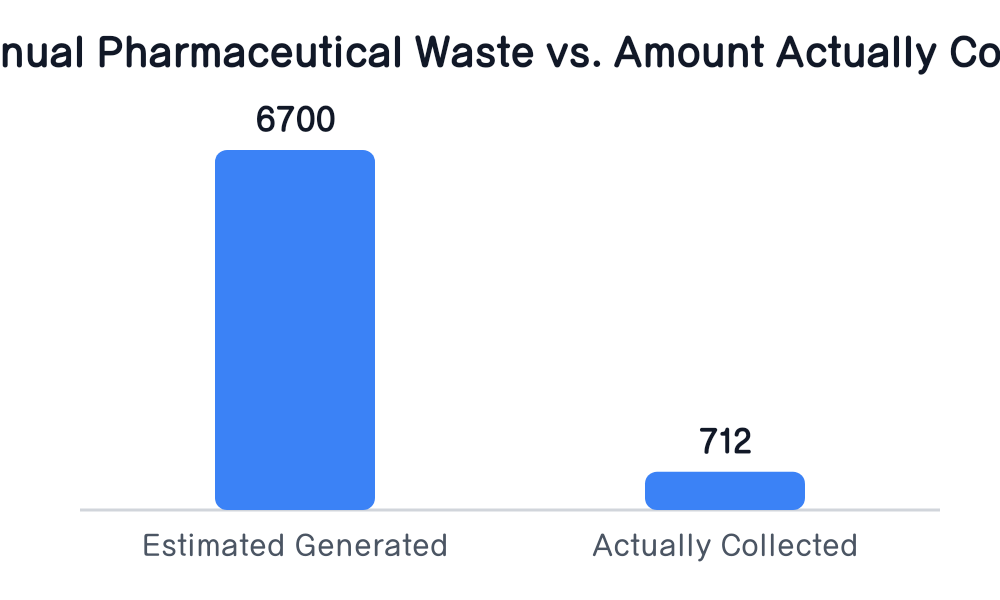
Among the 2,264 respondents who had discarded medications within the past year, 48.4% (1,096 people) disposed of them incorrectly — in general waste bags (32.9%), down the sink or toilet (7.0%), or in recycling bins (3.6%). Nearly half were doing it wrong. According to South Korea’s Ministry of Environment, the total amount of properly collected pharmaceutical waste nationwide reached a record high of 712.8 tons last year — but that’s only a fraction of the total generated. With the country entering a super-aged society and medication use on the rise, an estimated 6,700 tons of pharmaceutical waste are expected to be generated in 2025 alone. The current collection rate? Still hovering around just 10%.
The Right Way to Dispose of Each Type of Medication
The golden rule of pharmaceutical waste disposal is simple: use a designated collection bin. But the preparation steps vary by medication type, which is where most people get confused.
- Tablets and capsules: Remove all packaging — blister packs, paper, and boxes — and place only the pills in a sealed bag before dropping them in the collection bin.
- Powder medications: Do not open the packaging. Place the sealed packet directly in the collection bin to prevent the powder from becoming airborne.
- Liquid medications and syrups: Seal the cap tightly to prevent leaks. If the medication is in a glass bottle, transfer the contents to a plastic dosing bottle before disposal.
- Ointments, eye drops, and nasal sprays: Do not try to remove the contents from their original containers. Drop the entire container — as-is — into the collection bin.
- Prescription medication bags: Separate the labeled bag (which contains your personal information) and dispose of it in regular trash. Place only the medications themselves in the pharmaceutical waste bin.
Can’t Find a Collection Bin? Here’s How to Locate One Right Now
The biggest barrier to proper disposal isn’t laziness — it’s access. In surveys, the most common reason people gave for not using designated disposal bins was difficulty finding one nearby (30.9%). But collection points are closer than you might think.
- Local pharmacies: Many neighborhood pharmacies keep a dedicated pharmaceutical waste collection bin on-site.
- Community centers, public health centers, and district offices: The most universally accessible disposal locations across the entire country.
- Mailboxes (Seoul only): Seoul has partnered with Korea Post to enable 24-hour pharmaceutical waste drop-off through public mailboxes. Pick up a designated envelope at your local community center, place your medications inside, and drop it in any mailbox.
- Online search: Search “pharmaceutical waste collection bin” on Korea’s Public Data Portal, or if you’re in Seoul, use the Smart Seoul Map to instantly find the nearest drop-off location.
Personal Responsibility Isn’t Enough — The System Needs to Change Too
Individual action matters, but there’s growing consensus that this problem demands a structural solution. In British Columbia, Canada, pharmaceutical companies are required by law to provide free medication return and collection services and submit annual reports on their disposal programs. In the United States, Extended Producer Responsibility (EPR) legislation mandates that pharmaceutical manufacturers handle the disposal of their own products. South Korea, by contrast, still relies largely on voluntary collection programs — which explains the persistently low participation rates.
It has now been eight years since pharmaceutical waste was officially designated as hazardous household waste in South Korea in 2017, yet the collection rate remains stuck at around 10%. If we truly understand that the way we dispose of a single bottle of pills can ripple out to affect our rivers, ecosystems, and ultimately our own health, then maybe it’s time to think twice before cleaning out the medicine cabinet the easy way.
Sources
- “50% of the Public Doesn’t Know” — Leftover Medications Piling Up at Home Are Being Thrown in the Trash — Herald Economy
- More Dangerous Than Dead Batteries — Pharmaceutical Waste Collection Rate Sits at Just 10% — Korea Economic Daily
- “9 in 10 Say They Know — But Nearly Half Are Disposing of Medications Incorrectly” — A Better Future
- Leftover Medications Don’t Belong in Your Trash Bag — Use a Pharmaceutical Waste Collection Bin — Newspim
- Pharmaceutical Waste Collection Still Dependent on Pharmacies — Formal Regulation Remains Stalled — Korea Pharm News